Summary
- My MSc thesis measures the social inclusion of preschool children with hearing loss from wearable sensor data, comparing them with typically hearing peers within each classroom activity context rather than over a whole day.
- Ultra-wideband positions and LENA audio are fused into 21,847 child-minutes, spatial groups are found as dominant sets of an orientation-aware affinity matrix, and six activity contexts are discovered with a Gaussian Mixture Model whose K is chosen by a stability-aware BIC rule.
- Linear mixed models with per-context contrasts and false discovery rate correction show effects that change sign between contexts and cancel out over the day, such as children with hearing loss spending more time in groups during independent work (d = +1.59) and less during peer-driven activity.
- The most consistent finding is peer affiliation: children with hearing loss spend more grouped time in mixed groups than their typically hearing peers in all six contexts, significantly in four.
Overview
In inclusive classrooms, the physical presence of children with hearing loss (HL) does not guarantee social inclusion with their typically hearing (TH) peers. Self-report is biased, and manual observation cannot cover a full school day at fine temporal resolution. Inclusion also varies with what the class is doing, and a daily average can hide context-specific effects of opposite sign. The thesis therefore labels every child-minute with an activity context discovered from wearable sensors, and compares HL and TH children within each context.
RQ1. Can interpretable latent activity contexts be recovered from fused ultra-wideband (UWB) spatial data and LENA acoustic data using unsupervised clustering?
RQ2. Within each context, do HL and TH children differ on three sensor-derivable markers of inclusion: peer co-presence, vocal participation rate and peer affiliation patterns?
Data
One inclusive preschool classroom with 13 children (6 HL, 7 TH), recorded over 13 days for about 164 minutes per child per day. Each child wears two UWB tags, giving position and shoulder orientation at 10 Hz, and a LENA recorder whose audio is classified into speaker-type segments. After multimodal fusion, 21,847 attendance-confirmed child-minutes enter the analysis.
Pipeline
UWB (10 Hz) -> displacement, teacher distance, spatial groups (Dominant Sets) --+
                                                                              +-> join per (child, minute)
LENA audio  -> adult words, overlap, utterances per minute ---------------------+
   -> room-level mean (≥ 3 children) -> Yeo-Johnson -> GMM, stability-aware K -> LMM per context
Position is needed to measure co-presence and grouping, and audio to measure vocal participation, so the two streams are joined on (child, minute) as a complete case. LENA segments that straddle a minute boundary are split proportionally, which conserves totals. Displacement is summed per minute rather than converted to a velocity, which would amplify position noise.
Method
Spatial groups
Following an earlier pipeline for the same cohort, each frame gets a pairwise affinity A_ij = exp(−d_ij² / 2σ²) × max(0, u_ij·d_i) × max(0, −u_ij·d_j), the product of a Gaussian proximity kernel (σ = 0.5 m, personal distance scaled to preschoolers) and a mutual-orientation term. The product form means that children who are close but back to back, or facing each other from several metres away, score zero. Groups are extracted as dominant sets of the affinity matrix by replicator dynamics, preferred over partitioning methods such as k-means because groups vary in size and not every child must belong to one. Each group is labelled HL-only, TH-only or mixed.
Context features
Each minute is described by four room-level features averaged over the children present: adult word count, auditory overlap, cumulative displacement and teacher distance. They cover the moderators of communicative demand identified in the literature, are shared by everyone in the room, and exclude the behavioural outcomes to avoid circularity. Time of day is excluded to avoid leaking the routine into the clusters, and minutes with fewer than three children are dropped. Because the features are strongly right-skewed and contain zeros, a per-feature Yeo-Johnson transformation is applied rather than Box-Cox or a fixed log transform.
Context discovery
A full-covariance Gaussian Mixture Model is used rather than k-means because it gives posterior memberships, suited to gradual classroom transitions, and models correlated features. It also has a lower BIC than diagonal and spherical covariance. Hard assignment costs little: the median posterior of the assigned component is 0.90.
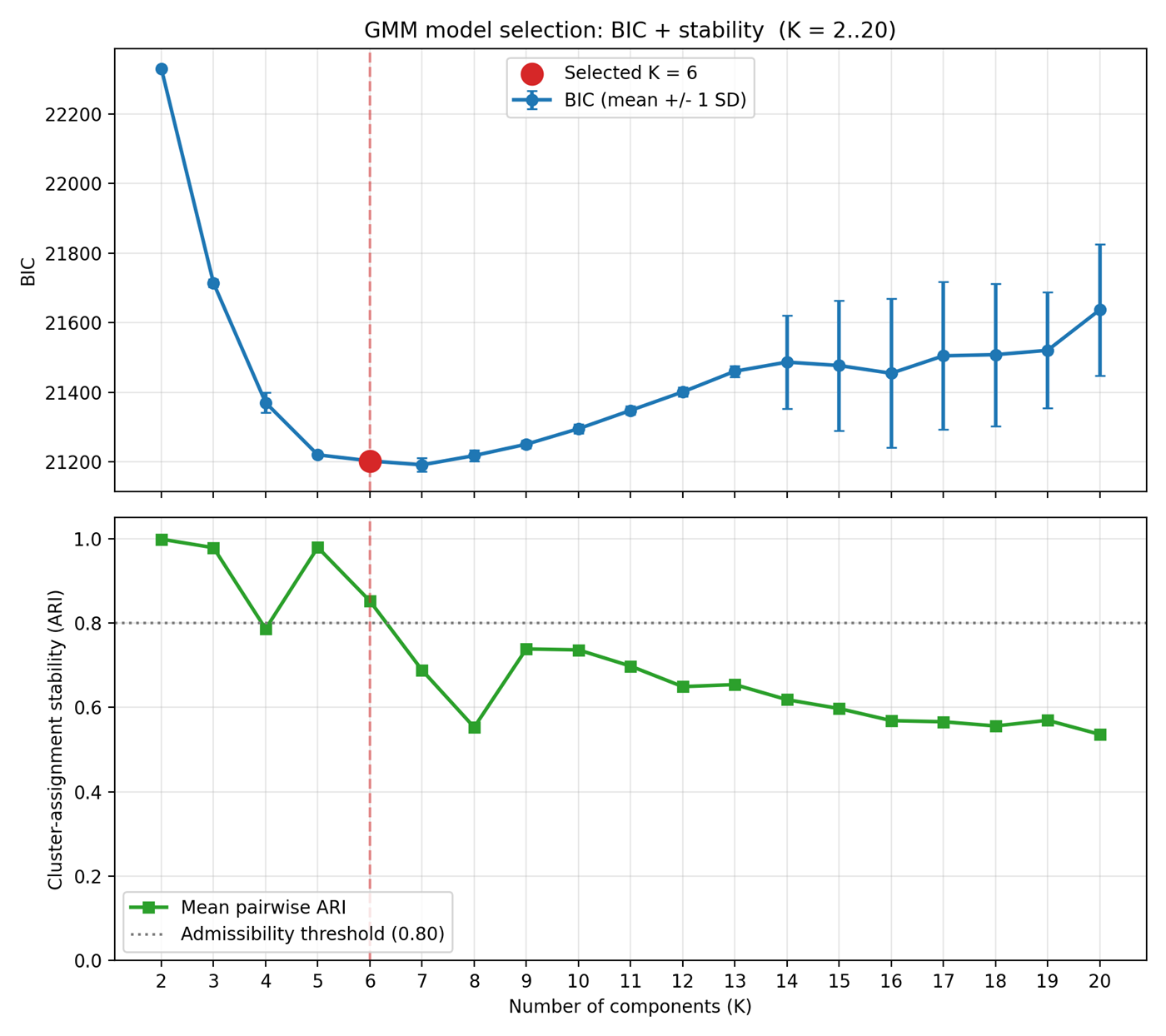
Since BIC alone tends to settle on shallow minima that reflect fitting noise, K is selected with a stability-aware rule. For each K from 2 to 20, twenty GMMs are fitted with independent seeds. A K is admissible only if its partitions agree across seeds (mean pairwise adjusted Rand index of at least 0.80), and the admissible K with the lowest mean BIC is chosen. This gives K = 6, and the choice holds for any threshold between 0.70 and 0.85.
Statistical inference
Each child contributes many correlated minutes, so each outcome is modelled with a linear mixed model: cluster, hearing status and their interaction as fixed effects and a random intercept per child, with per-context Wald contrasts between HL and TH children. Random slopes would be under-identified with 13 children and six clusters. The homophily index, one value per child per context, is tested with Mann-Whitney U. Benjamini-Hochberg false discovery rate correction is applied within each marker's six contrasts, as a family-wise correction would cost too much power in an exploratory study of this size.
Results
Recovered activity contexts
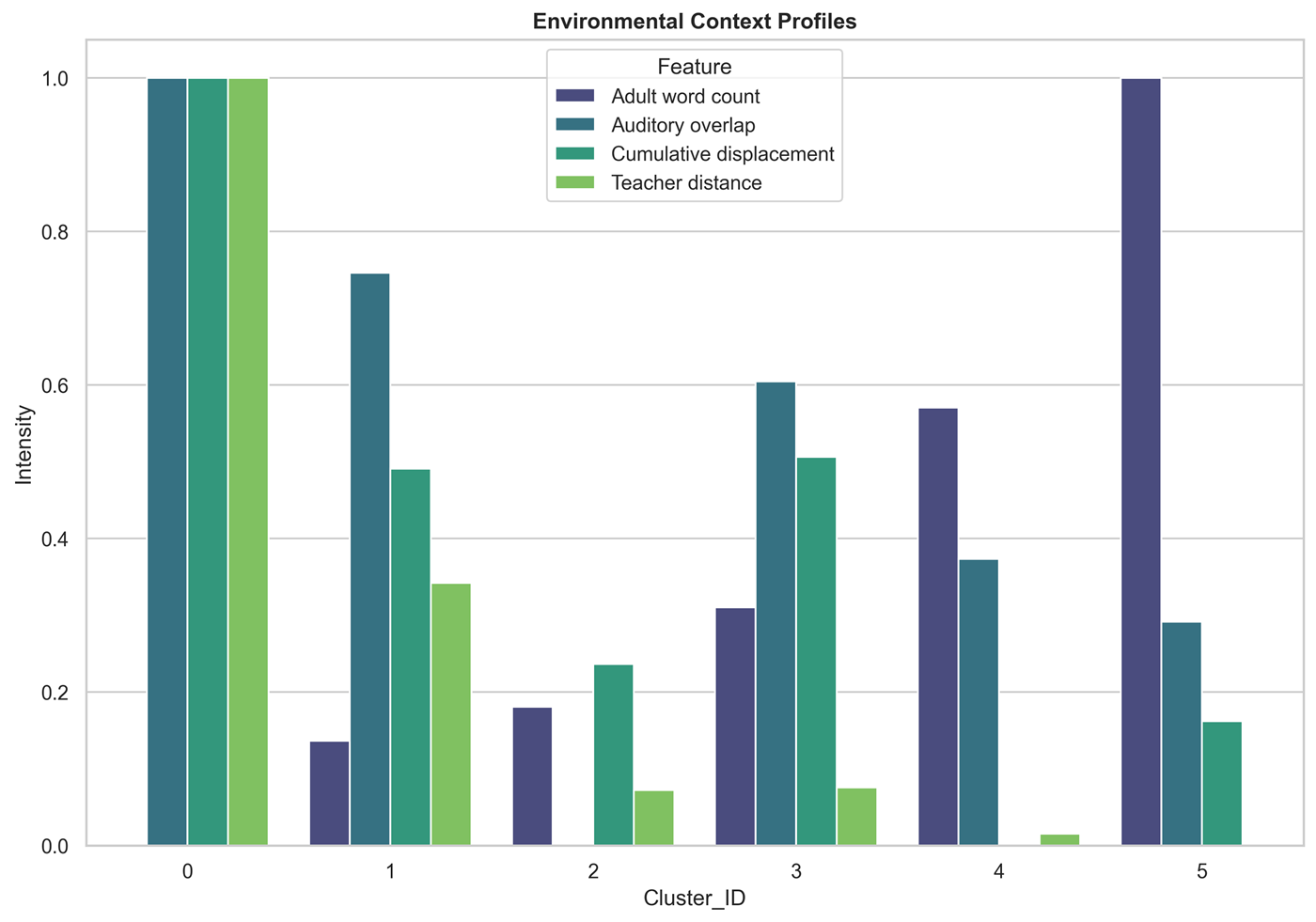
| Cluster | Descriptive label | Share of time | Sensor signature |
|---|---|---|---|
| 0 | Dispersed transition | 6.9% | Least adult speech, most movement, teacher furthest away (9.4 m) |
| 1 | Peer-driven activity | 6.0% | Little adult speech, high overlap, teacher at a distance (4.2 m) |
| 2 | Independent / parallel work | 8.6% | Quietest room, fewest utterances |
| 3 | Adult-scaffolded peer activity | 33.9% | Peer speech dominates while a teacher stays close (2.1 m) |
| 4 | Seated guided work | 9.8% | High adult speech, least movement, teacher at 1.6 m |
| 5 | Whole-class instruction / read-aloud | 34.8% | Most adult speech (66 words per minute), teacher closest |
The labels are post-hoc descriptions of the sensor profiles. All tests are run on cluster numbers. The contexts are qualitatively consistent with an independent manual coding of the daily routine, consulted only after K was fixed.
Peer co-presence
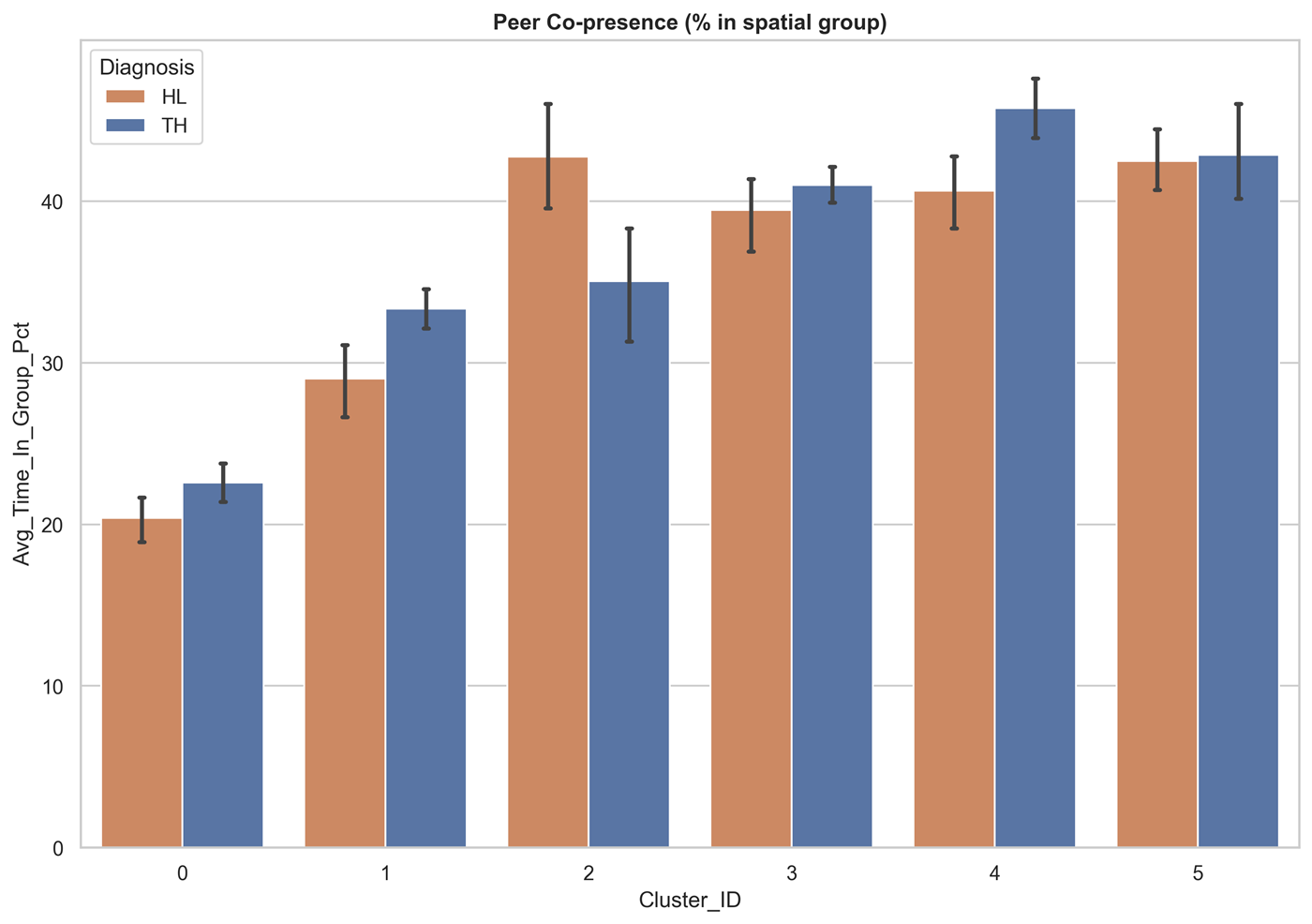
The difference changes sign between contexts. HL children are in groups more than TH children during independent work (+7.8% of the minute, d = +1.59, q < 0.0001), and less during peer-driven activity (−4.3%, q = 0.02) and seated guided work (−5.3%, q = 0.002). Pooled over the day the two groups look the same (38.8% against 39.9%), because these effects cancel out.
Vocal participation
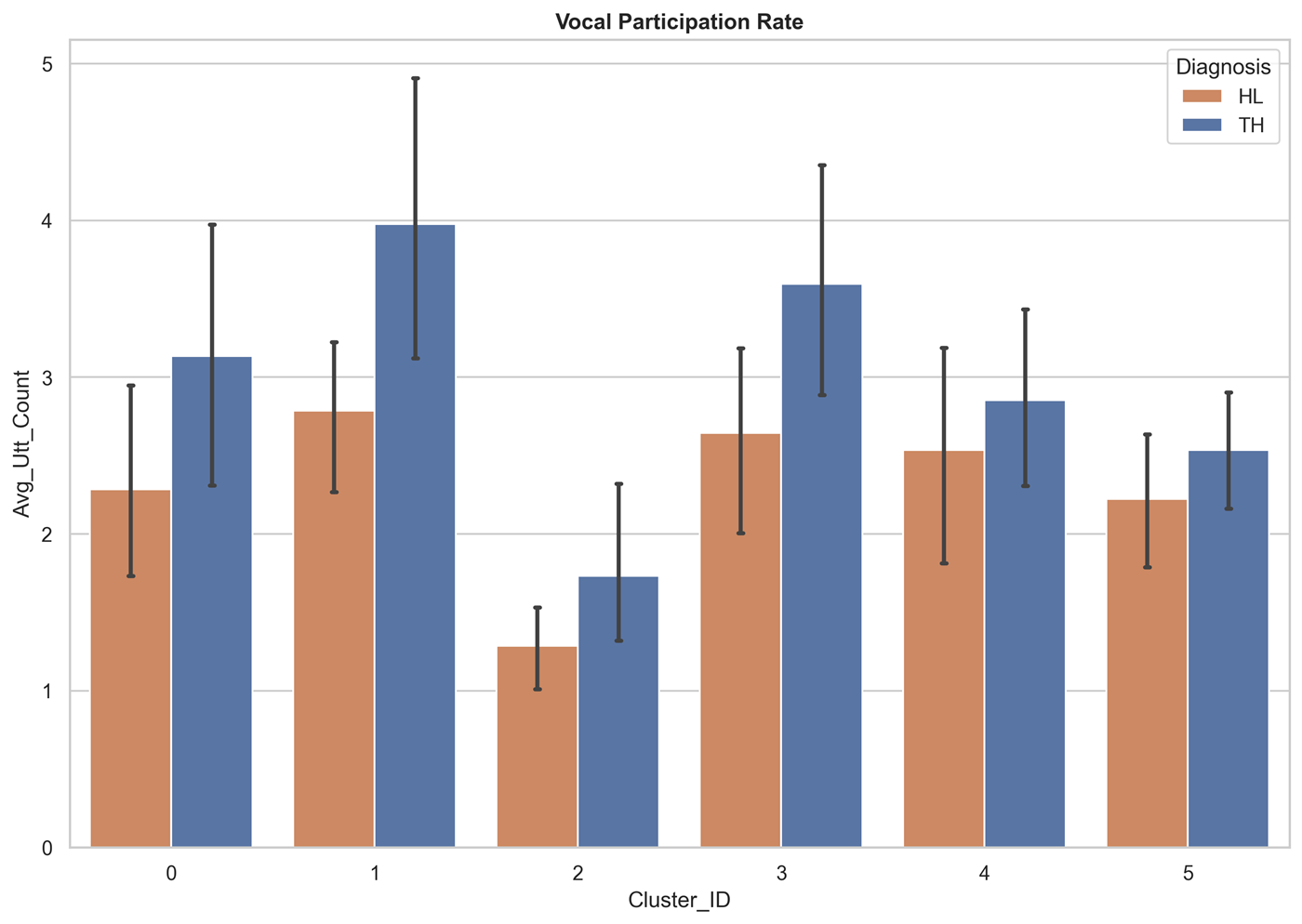
HL children speak less where fast peer talk dominates and adult scaffolding is reduced: peer-driven activity (q = 0.034) and adult-scaffolded peer activity (q = 0.048). Where adult speech dominates or the room is quiet, the gap is small and not significant.
Peer affiliation
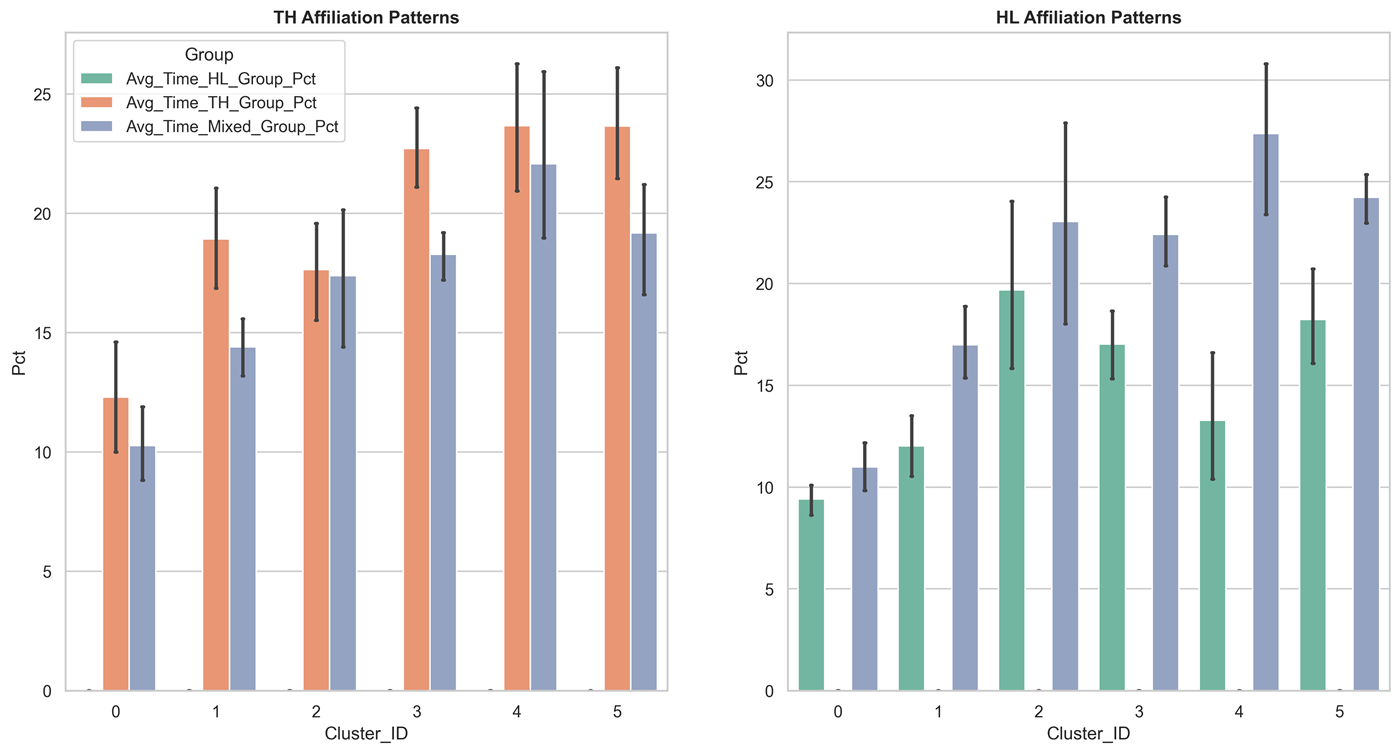
This is the most consistent asymmetry. TH children's grouped time is concentrated in TH-only groups, while HL children spend more grouped time in mixed groups than TH children in all six contexts, significantly in four. Class composition alone gives TH children a homophily advantage of about 0.08. In the four significant contexts the observed gap is 0.12 to 0.19, and it is as large in teacher-organised contexts as in child-chosen ones.
Interpretation
Conditioning on context reveals effects that a whole-day comparison averages away. The per-child random intercept matters for the same reason: a simpler ANOVA would report no effect of hearing status on vocal participation, while the mixed model shows that the signal is concentrated in specific contexts. The results were presented to developmental psychologists.
Key takeaways
- Analyses should be conditioned on context, since effects of opposite sign can cancel out in a daily average.
- Peer affiliation was the most consistent difference, with the same direction in all six contexts.
- Selecting the number of clusters for stability rather than by BIC alone yielded contexts that were reproducible across random seeds.
The recordings of minors were collected under a research-ethics protocol that does not permit public release.